
Learning Spanish opens doors to rich cultural experiences and communication with millions worldwide. This guide provides a comprehensive introduction, helping beginners build a strong foundation in Spanish language basics through practical exercises and essential vocabulary. Perfect for those starting their linguistic journey, this resource ensures a smooth transition into speaking, reading, and understanding Spanish with confidence. Discover the beauty of the Spanish language and unlock new opportunities for personal and professional growth. This beginner-friendly PDF guide is your key to mastering Spanish step-by-step, making learning enjoyable and accessible for everyone. Start your Spanish adventure today and embrace the vibrant world of Hispanic culture and traditions. ¡Vamos a empezar! (Let’s get started!)
Why Learn Spanish?
Learning Spanish unlocks access to a rich cultural heritage and enhances career opportunities. As the second most spoken language globally, Spanish connects you to over 460 million native speakers. It improves travel experiences, fosters deeper connections with Spanish-speaking communities, and broadens your understanding of literature, music, and film. Spanish skills are highly valued in industries like business, healthcare, and education. Mastering Spanish also enhances cognitive abilities and opens doors to new perspectives in our increasingly interconnected world. Start your journey today and discover the countless benefits of speaking Spanish.
Overview of Spanish Language Basics
Spanish language basics include understanding the alphabet, pronunciation, and fundamental grammar rules. The Spanish alphabet consists of 27 letters, with additional sounds like ñ and ü. Pronunciation is generally phonetic, making it easier to learn. Grammar basics involve gendered nouns, verb conjugations, and sentence structure. Mastering these elements provides a solid foundation for clear communication. This section introduces learners to the essential building blocks of the Spanish language, ensuring a smooth transition into more complex topics. Start with the basics to build confidence and fluency in Spanish.
Importance of Learning Spanish in Today’s World
Learning Spanish is invaluable in today’s globalized world, with over 460 million native speakers. It enhances career opportunities in fields like business, healthcare, and education. Spanish proficiency opens doors to cultural enrichment, allowing deeper connections with Spanish-speaking communities. It also boosts travel experiences and access to rich literary and cinematic traditions. In a competitive job market, speaking Spanish gives you an edge, fostering personal and professional growth. Embrace this widely spoken language to expand your horizons and opportunities in an increasingly interconnected world.
Understanding the Spanish Alphabet and Pronunciation
The Spanish alphabet includes 27 letters, with additional sounds like ñ and ü. Pronunciation is generally phonetic, making it easier to learn and speak confidently from the start.
The Spanish Alphabet: Letters and Sounds
The Spanish alphabet consists of 27 letters, including ñ, ü, and the digraphs ch, ll, and rr. These letters produce distinct sounds, with pronunciation generally consistent across words. Unlike English, Spanish letters are pronounced similarly in most contexts, making it easier to learn and speak. For example, the letter ‘c’ can sound like ‘k’ or ‘s,’ while ‘z’ varies by region, sounding like ‘s’ or ‘th.’ The ‘r’ sound is rolled, adding a unique flavor to words like ‘rojo’ (red).
Understanding the sounds of each letter is crucial for proper pronunciation. For instance, ‘t’ is pronounced as ‘t’ in ‘toma’ (he/she takes), while ‘h’ is silent in ‘hola’ (hello). Stress on syllables can also change meaning, such as in ‘caminar’ (to walk) vs. ‘caminar’ (to walk). Mastering these sounds will help you speak Spanish confidently and clearly, building a strong foundation for further learning.
Accents and Diacritical Marks in Spanish
Spanish uses accents and diacritical marks to indicate pronunciation and stress. The acute accent (á, é, í, ó, ú) shows where a syllable is stressed. The diaeresis (ü) changes pronunciation, as in siüdo (si-udo). The stress accent (énfasis) highlights syllables needing emphasis. These marks are essential for correct pronunciation and meaning, helping learners avoid confusion. For example, si (if) vs. sí (yes) differ only by an accent. Mastering these marks improves communication and enhances language skills.
Basic Pronunciation Rules for Beginners
Mastering Spanish pronunciation starts with understanding letter sounds. Most letters have consistent sounds, unlike English. The c sounds like s before e or i, and like k otherwise. The g is soft before e or i and hard otherwise. Accents like the acute (á) indicate stress on a syllable. The rr is rolled, while b and v are pronounced similarly. Practice diphthongs (e.g., au, ue) for smooth speech. Listening to native speakers and practicing daily will help you refine your pronunciation skills effectively.
Basic Grammar Rules for Spanish Beginners
Mastering basic Spanish grammar involves understanding verb conjugations, noun gender, and sentence structure. Start with regular verbs in the present tense and learn common irregular verbs. Nouns are either masculine or feminine, and adjectives must agree. Practice simple sentences and question formation. This foundation will build your confidence in speaking and writing Spanish effectively.
Gender in Spanish: Masculine and Feminine Nouns
In Spanish, nouns are classified as masculine or feminine. Most masculine nouns end in -o (e.g., el libro), while feminine nouns end in -a (e.g., la casa). Some nouns ending in -e, -d, or -ción can be either gender. Exceptions exist, like la mano (feminine despite ending in -o). Understanding gender is essential for using correct articles (el/la) and adjectives. Practice identifying gender by memorizing common noun endings and exceptions to build a strong foundation in Spanish grammar.
Number Agreement: Singular and Plural Forms
In Spanish, nouns and adjectives must agree in number. Singular nouns end in -o, -a, or -e, while plurals add -s or -es (e.g., el libro → los libros, la casa → las casas). Some nouns ending in -z change to -ces in the plural (e.g., la vez → las veces). Adjectives must match the noun’s number, ensuring clear and accurate communication. Mastering number agreement is key to forming correct sentences in Spanish.
Basic Sentence Structure in Spanish
Spanish sentences typically follow a Subject-Verb-Object (SVO) structure, similar to English. For example, Yo como una manzana (I eat an apple). The subject (yo) comes first, followed by the verb (como), and then the object (una manzana). Adjectives usually precede nouns, and adverbs often follow verbs. While word order is flexible in Spanish, especially in formal writing, the SVO structure is the most common and easiest for beginners to learn. Mastering this structure will help you form clear and grammatically correct sentences.
Vocabulary Building for Beginners
Start with common phrases, essential words, and practical terms for everyday communication. Focus on greetings, numbers, and basic expressions to build a strong foundation. Use flashcards and practice exercises to expand your vocabulary gradually, ensuring confidence in conversational Spanish.
Common Greetings and Phrases
Mastering basic greetings and phrases is essential for effective communication in Spanish. Start with simple expressions like Hola (Hello), Buenos días (Good morning), and Buenas tardes (Good afternoon). Learn to introduce yourself with Me llamo (My name is) and ask for others’ names using ¿Cómo te llamas? (What’s your name?). Practice common questions like ¿Dónde está…? (Where is…) and ¿Cuánto cuesta? (How much does it cost?). Use polite expressions like Por favor (Please) and Gracias (Thank you). Familiarize yourself with formal and informal language to suit different situations. These phrases will help you build confidence in everyday conversations and create a solid foundation for further learning. Regular practice ensures fluency and accuracy in using these essential expressions.
Numbers and Counting in Spanish
Learning numbers in Spanish is fundamental for everyday communication. Start with basic counting: uno (1), dos (2), tres (3), up to diez (10). For teens, use once (11), doce (12), and quince (15). Tens include veinte (20), treinta (30), and cuarenta (40). Combine numbers like veintiuno (21) or treinta y cinco (35). Practice counting objects, days of the week, and months. Understanding numbers aids in tasks like telling time, shopping, and navigating. Regular practice ensures mastery of Spanish numerals, enhancing your language skills effectively.
Basic Vocabulary for Food and Drinks
Mastering basic food and drink vocabulary in Spanish is essential for everyday conversations. Start with common terms like comida (food) and bebida (drink). Learn meal-related words: desayuno (breakfast), almuerzo (lunch), and cena (dinner). Familiarize yourself with food items like pan (bread), frutas (fruits), and verduras (vegetables). For drinks, know agua (water), jugo (juice), and café (coffee). Practice phrases like ¿Dónde está el restaurante? (Where is the restaurant?) and Un café, por favor (A coffee, please). This vocabulary will help you navigate menus, grocery shopping, and social dining experiences in Spanish-speaking environments. Regular practice ensures confidence in ordering food and discussing meals effectively.
Family and Relationships Vocabulary
Learning family and relationships vocabulary in Spanish is vital for building connections. Start with basic terms like familia (family), padre (father), madre (mother), and hermano (brother). Expand to hermana (sister), hijo (son), and hija (daughter). Understand relationships like esposo (husband), esposa (wife), abuelo (grandfather), and abuela (grandmother). Practice phrases such as ¿Cuántos hermanos tienes? (How many siblings do you have?) and Me gusta pasar tiempo con mi familia (I like spending time with my family). This vocabulary helps in describing personal connections and building rapport in Spanish-speaking contexts. Regular practice ensures fluency in discussing family and relationships effectively.
Colors and Days of the Week
Mastering colors and days of the week in Spanish is essential for everyday communication. Colors like rojo (red), azul (blue), and verde (green) are foundational. Learn days such as lunes (Monday), martes (Tuesday), and domingo (Sunday). Practice phrases like ¿De qué color es esto? (What color is this?) and Hoy es miércoles (Today is Wednesday). This vocabulary helps in describing objects, planning schedules, and engaging in basic conversations. Regular practice ensures confidence in using these terms effectively in Spanish-speaking environments.
Months and Seasons in Spanish
Learning the months and seasons in Spanish is vital for discussing time and events. The months include enero (January), febrero (February), marzo (March), abril (April), mayo (May), junio (June), julio (July), agosto (August), septiembre (September), octubre (October), noviembre (November), and diciembre (December). The seasons are primavera (spring), verano (summer), otoño (autumn), and invierno (winter). Practice phrases like ¿Cuál es tu mes favorito? (What’s your favorite month?) or Me gusta el verano (I like summer). Associating months with personal events or using flashcards can aid memorization. Understanding these terms enhances your ability to communicate about time and preferences in Spanish.
Common Phrases and Expressions
Mastering common phrases is key to effective communication. Essential expressions like gracias (thank you), por favor (please), and ¿Dónde está…? (where is…) are everyday necessities. Learn these to build confidence in conversations and navigate daily situations effortlessly while immersing in Spanish-speaking environments. These phrases are foundational for clear and polite interactions, making them indispensable for beginners. Start with simple, widely-used expressions to enhance your communication skills and connect with native speakers seamlessly. Practice regularly to ensure fluency and accuracy in using these essential phrases. ¡Buena suerte! (Good luck!)
Useful Phrases for Everyday Conversations
Mastering everyday phrases is essential for effective communication. Start with greetings like Hola, ¿cómo estás? (Hello, how are you?) and Buenos días (Good morning). Learn polite expressions such as gracias (thank you), por favor (please), and lo siento (sorry). Ask for help with ¿Dónde está…? (where is…) or ¿Puedes ayudarme? (can you help me?). Use ¿Cuánto cuesta? (how much does it cost?) for shopping and ¿Habla inglés? (do you speak English?) for assistance. Express appreciation with me encanta (I love it) or está delicioso (it’s delicious). For making choices, say Me gustaría… (I would like…) or ¿Qué recomiendas? (what do you recommend?). Practice these phrases daily to build confidence in Spanish conversations.
Expressing Emotions and Feelings in Spanish
Learning to express emotions in Spanish helps connect with native speakers. Start with basic feelings like soy feliz (I’m happy) or estoy triste (I’m sad). Say me encanta (I love it) or me gusta (I like it). Express anger with estoy enojado (I’m angry) and fear with tengo miedo (I’m scared). Share excitement with estoy emocionado (I’m excited) or surprise with estoy sorprendido (I’m surprised). Use phrases like te quiero (I love you) or te amo (I love you) for affection. Practice these expressions to convey emotions effectively in conversations.
Asking for Directions and Help
Mastering phrases for asking directions is essential in Spanish. Start with ¿Dónde está…? (Where is…?) for locations like el baño (the restroom) or la estación (the station). Use ¿Cómo se llama…? (What is… called?) for names of places. Say ¿Puedes ayudarme? (Can you help me?) for assistance. Ask ¿Habla inglés? (Do you speak English?) if needed. Use izquierda (left), derecha (right), adelante (forward), and atrás (back) for directions. Practice numbers like primer piso (first floor) or segunda planta (second floor). Don’t forget polite phrases like gracias (thank you) and por favor (please) to show appreciation. These phrases will help you navigate confidently in Spanish-speaking environments.
Resources for Learning Spanish
Discover essential resources like Spanish language for beginners PDF guides, offering structured lessons and exercises. Explore language learning apps such as Duolingo and Babbel for interactive practice. Utilize online courses and tutorials for comprehensive learning. Enhance your skills with workbooks and interactive exercises designed for beginners. These tools provide a well-rounded approach to mastering Spanish effectively.
Best PDF Resources for Spanish Beginners

Beginners can benefit from high-quality Spanish language for beginners PDF resources. These guides often include grammar basics, vocabulary lists, and practice exercises. Popular options like Spanish for Beginners: A Comprehensive Guide and Basic Spanish Grammar Workbook are widely recommended. Many PDFs are free or low-cost, making them accessible to everyone. They are ideal for self-study, offering structured lessons and interactive activities. These resources are perfect for those who prefer learning at their own pace and complement other learning methods like apps and courses.

Recommended Spanish Language Learning Apps
For effective Spanish learning, apps like Duolingo, Babbel, and Rosetta Stone are highly recommended. These platforms offer interactive lessons, focusing on grammar, vocabulary, and pronunciation. Duolingo’s gamified approach makes learning fun, while Babbel provides comprehensive, structured courses. Rosetta Stone excels in immersive, audio-visual experiences. These apps are accessible on-the-go, making them ideal for busy learners. They complement PDF guides perfectly, offering a dynamic way to practice and reinforce Spanish skills. Start your journey with these tools and see progress in no time!
Online Courses and Tutorials for Beginners
Online courses are an excellent way to learn Spanish systematically. Platforms like Coursera, Udemy, and edX offer beginner-friendly courses with structured lessons. These courses often include video tutorials, interactive exercises, and quizzes to track progress. They cover essential topics like grammar, vocabulary, and pronunciation. Many courses are self-paced, allowing learners to study at their convenience. Additionally, some courses provide certificates upon completion, adding value to your learning journey. These resources complement PDF guides, offering a dynamic and engaging way to master Spanish basics.
Cultural Immersion and Practice
Cultural immersion enhances language learning through music, movies, and conversations. Engage with Spanish media, practice speaking with natives, and explore traditions to deepen your understanding and fluency naturally.
Listening to Spanish Music and Podcasts
Listening to Spanish music and podcasts is a fun, immersive way to improve your language skills. Exposure to native accents enhances pronunciation and rhythm. Choose music genres like flamenco or pop, and podcasts on topics you enjoy. This method boosts comprehension, introduces new vocabulary, and offers cultural insights. Regular listening helps build confidence and familiarity with spoken Spanish. Accessible and engaging, these resources make learning enjoyable while reinforcing your language foundation. Start exploring today and make Spanish a part of your daily routine!
Watching Spanish Movies and TV Shows
Watching Spanish movies and TV shows is an engaging way to immerse yourself in the language. It helps improve comprehension, pronunciation, and cultural understanding. Choose films or series with clear dialogue and engaging storylines. Use subtitles in Spanish or your native language to enhance learning. This method exposes you to real-life conversations, expressions, and contexts, making language acquisition more natural and enjoyable. Incorporate this practice into your routine to boost your listening and speaking skills effectively.
Practicing with Native Speakers
Practicing with native speakers is a powerful way to improve your Spanish skills. Engage in conversations to enhance pronunciation, intonation, and comprehension. Use language exchange platforms like Tandem or HelloTalk to connect with native speakers. Discuss topics of interest to build confidence and fluency. Don’t hesitate to ask for feedback or clarification. This interactive approach helps you learn authentic expressions, cultural nuances, and dialectal variations. Regular practice with native speakers accelerates your progress and makes learning Spanish more enjoyable and effective.

Writing and Speaking Skills
Mastering writing and speaking in Spanish involves practicing simple sentences, basic conversations, and pronunciation. Start with flashcards for vocabulary and focus on clear articulation to build confidence gradually.
Basic Writing Exercises for Beginners
Start with simple sentence writing using common verbs like ser and estar. Practice fill-in-the-blank exercises with vocabulary lists. Write short paragraphs describing daily routines or family members. Use flashcards to learn basic phrases and structure. Focus on proper grammar and spelling. Gradually incorporate new vocabulary into sentences. Engage in journaling to express thoughts and feelings in Spanish. These exercises build confidence and improve writing skills effectively for beginners.

Improving Speaking Confidence
Practice speaking daily, even for a few minutes. Start with simple phrases and gradually build complexity. Use language apps or flashcards to learn common expressions. Speak with native speakers or join conversation groups to gain confidence. Record yourself to track progress and identify areas for improvement. Focus on pronunciation and intonation by listening to native speakers. Don’t fear mistakes—learning comes from practice. Celebrate small victories to stay motivated. Consistency is key to becoming a confident Spanish speaker. ¡Sigue adelante! (Keep going!)
Listening and Reading Comprehension
Enhance your Spanish skills with simple listening and reading exercises. Start with basic texts and audio materials, gradually increasing difficulty. Practice daily to build confidence and fluency.
Simple Listening Exercises

Start with short audio clips featuring clear, slow speech. Listen to basic phrases, greetings, and simple conversations. Repeat phrases aloud to improve pronunciation and comprehension. Gradually move to slightly faster dialogues. Use podcasts or videos designed for beginners. Pay attention to common expressions and question formats. Take notes on unfamiliar words or phrases. Practice daily to build confidence and familiarity with the sounds of Spanish. This foundational skill will enhance your ability to understand and communicate effectively in Spanish.
Basic Reading Materials for Beginners
Begin with simple texts like children’s books or dual-language stories. Graded readers designed for learners are ideal, featuring basic vocabulary and grammar. Short stories or news articles in Spanish can also be effective. Look for materials with accompanying audio to improve comprehension. Flashcards and interactive PDF exercises are great for reinforcing new words. Start with short paragraphs and gradually move to longer texts. Practice reading aloud to enhance pronunciation and confidence. These materials provide a solid foundation for building reading skills in Spanish.
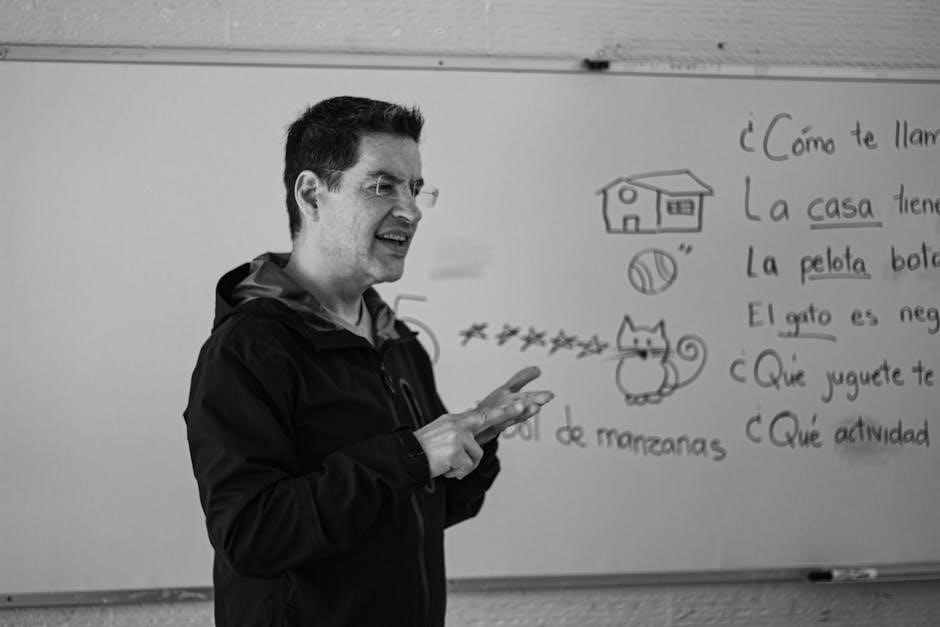
Practicing with Exercises and Quizzes
Engage with interactive exercises and quizzes to reinforce Spanish basics. These tools help improve vocabulary, grammar, and comprehension while tracking progress and building confidence in language skills effectively.
Online Quizzes for Spanish Beginners
Enhance your Spanish learning journey with online quizzes designed for beginners. Platforms like Duolingo, Quizlet, and Babbel offer interactive tests to assess vocabulary, grammar, and comprehension skills. These quizzes provide immediate feedback, helping you identify strengths and areas for improvement. Many resources include multiple-choice questions, fill-in-the-blank exercises, and audio-based tests to simulate real conversations. Regular practice with these tools sharpens your language abilities and builds confidence. Accessible on both desktop and mobile, they offer flexibility for learners on the go. Utilize these quizzes to track progress and stay motivated in your Spanish learning adventure. They are often free or low-cost, making them an excellent addition to your study routine. Engage with these resources to make learning Spanish both enjoyable and effective.
Mastering Spanish as a beginner is achievable with dedication and the right resources. This guide provides a clear path to learning, ensuring a strong foundation for future growth. ¡Sigue adelante! (Keep going!)